
How to Change a Flat Tire in 8 Simple Steps
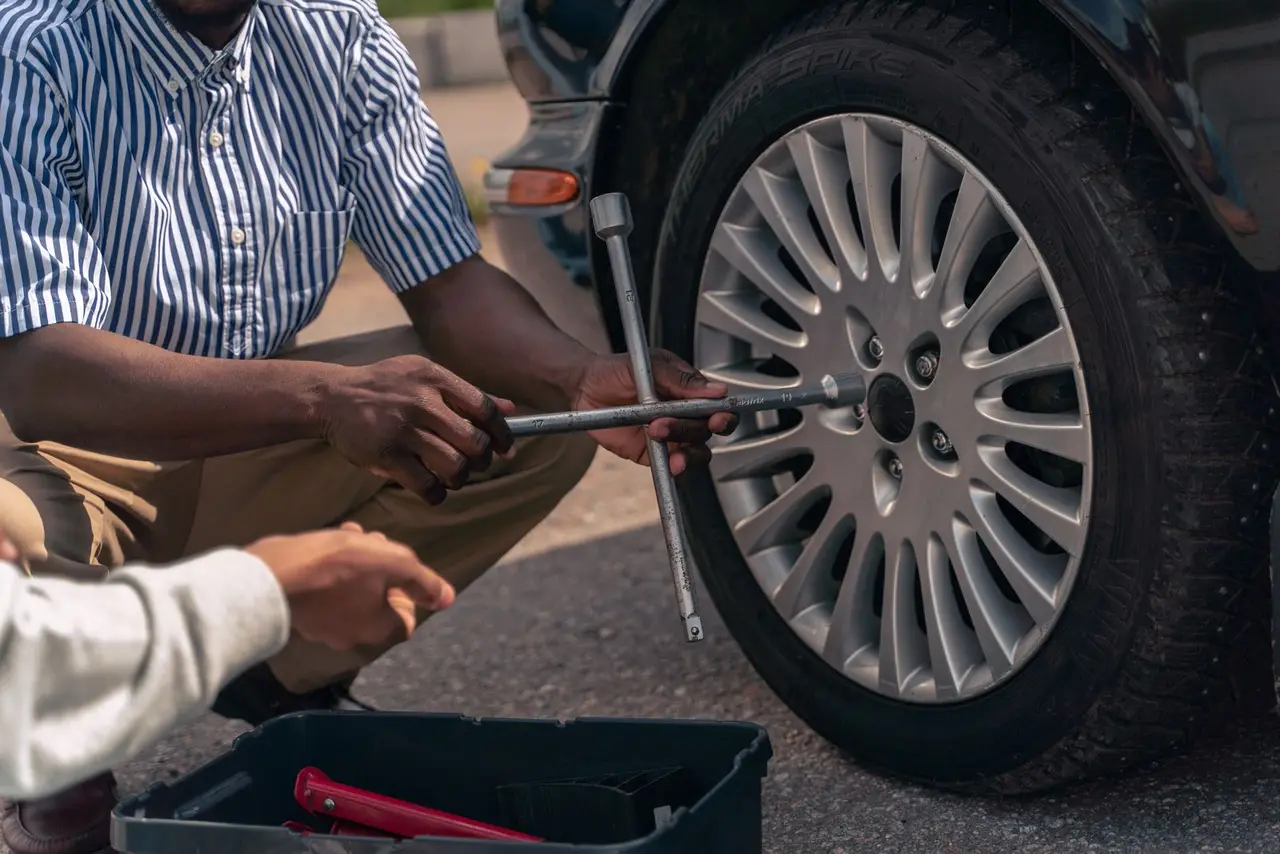
Knowing how to change a flat tire is one of those skills you hope you never need, then need on the shoulder of Stoney Trail at dusk in February. We swap wheels all day in our bay at 227 41 Ave NE, and the steps below are the same ones we would walk a friend through over the phone. Read it once now, check that your spare and jack are actually in the car, and you will be ready when it happens.
Is It Safe to Drive on a Flat Tire?
Short answer: no, not beyond the distance it takes to get off the road safely. A tire with little or no air lets the rim press the sidewall against the pavement. Within a few hundred metres the inner liner can be chewed up, the sidewall cords can break and the rim edge can bend. At that point a tire that could have been fixed with a simple flat tire repair has to be replaced.
It also changes how the car behaves. Steering pulls hard to the flat side, braking gets longer and on a wet or icy surface the car can step out without much warning. Run-flat tires are the exception: they are built to carry the car for a limited distance at reduced speed, and the numbers are printed in your owner's manual. Regular tires have no such allowance.
What to Do the Moment You Get a Flat
The first minute matters more than the repair. Here is what we tell customers:
- Do not brake hard. Hold the wheel firmly, ease off the gas and let the car slow down in a straight line.
- Signal and move right. Get as far from traffic as you can. An exit ramp or a side street beats the shoulder of Deerfoot every time.
- Pick flat, firm ground. A jack on a slope or soft gravel is how cars fall off jacks.
- Hazards on, everyone out on the safe side. Passengers wait well away from the road, not beside the car.
- Decide honestly. If traffic is heavy, the shoulder is narrow or it is -30°C and dark, call roadside assistance or a tow instead of doing it yourself.
How to Change a Flat Tire: The 8 Steps
What You Need Before You Start
Most cars carry the basics under the trunk floor or on the side panels. Check them today, not on the roadside:
- Spare tire (full-size or compact "donut"), with air in it
- Jack and jack handle
- Lug wrench, plus the wheel lock key if your car has locking lug nuts
- Owner's manual, which shows your jack points
- Wheel wedges or a couple of solid blocks
- Gloves, a flashlight and a reflective triangle or vest
Step 1: Secure the Car
Put it in park (or first gear on a manual), set the parking brake hard and turn the engine off. Place wheel wedges against the tire diagonally opposite the flat, so the car cannot roll when it is lifted.
Step 2: Remove the Hubcap and Loosen the Lug Nuts
Pop off any wheel cover. With the tire still on the ground, turn each lug nut counter-clockwise about half a turn. Just break them loose; do not remove them yet. If a nut will not budge, put your foot on the wrench and use your body weight rather than jerking it.
Step 3: Place the Jack at the Correct Lift Point
Your manual shows the reinforced jack points, usually a notched pinch weld just behind the front wheel or in front of the rear wheel. Lifting on the floor pan or a plastic rocker panel will crush it and can let the car slip.
Step 4: Raise the Vehicle
Jack the car until the flat tire is about 5 cm off the ground. The spare is fully inflated, so it needs more clearance than the flat. Never put any part of your body under the car while it is on the jack.
Step 5: Remove the Lug Nuts and the Flat
Spin the nuts off the rest of the way and keep them together in a pocket or the hubcap. Grip the tire at the sides and pull it straight toward you. Lay it flat so it cannot roll into traffic.
Step 6: Mount the Spare
Line the holes in the spare up with the wheel studs and push it on until it sits flat against the hub. On a rusty Calgary hub the wheel can be stubborn; a firm push at the top of the tire usually seats it.
Step 7: Hand-Tighten the Lug Nuts
Thread each nut on by hand with the tapered side facing the wheel, then snug them with the wrench in a star (criss-cross) pattern. This pulls the wheel on evenly instead of cocking it to one side.
Step 8: Lower the Car and Tighten Fully
Lower the jack until the tire carries weight, then tighten each nut firmly in the same star pattern. Take the jack out, check the spare pressure and stow everything. Have the lug nuts torqued to spec after the first 50 to 100 km, because wheels can settle.
Can You Fix a Flat Tire Yourself?
You can get yourself moving again. A plug kit or a can of sealant can close a small tread puncture well enough to drive to a shop, and our tire repair kit guide explains how each type works. What you cannot do on the roadside is see the inside of the tire. A proper repair means taking the tire off the rim, checking the inner liner for damage from being driven soft, and sealing the hole from the inside with a one-piece plug-patch.
So think of a DIY fix as a way to get home, not a permanent answer. If you found a screw rather than a blown tire, our post on whether you can drive with a nail in your tire covers what to check first.
When to Leave It to a Tire Shop
Swapping on the spare is the easy part. Bring the car to a shop when:
- The damage is in the sidewall or shoulder, or there is a bulge or a long cut. That tire needs replacing, and we can match it with a new or an inspected used tire.
- You drove on the flat for any distance, even if the outside looks fine.
- The rim edge is bent or chipped, often after a spring pothole.
- The tire pressure light stays on after the spare goes on. Many compact spares have no sensor, and a damaged sensor may need attention from our TPMS sensor service.
- A lug nut or stud is stripped, or you could not reach the torque you needed.
Compact spares are usually limited to around 80 km/h and a short distance; the exact limit is printed on the spare's sidewall or a sticker. Treat it as a way to get to us, not something to leave on for the week. You can find our hours and directions on the contact page.
We Can Help With Your Flat Tire
Drive in on your spare Monday to Saturday, 9 to 6, at 227 41 Ave NE. We will inspect the flat, repair it if it is safe to do so and put your wheel back on at the correct torque. Call (587) 894-3516 first if you want us to expect you.
FAQ: Changing a Flat Tire
How long does it take to change a flat tire?
For most people it takes 15 to 30 minutes the first time, and less once you have done it before. Stuck lug nuts, a rusted hub or a spare buried under luggage add time. In deep cold or heavy traffic, calling roadside assistance is often the smarter and safer choice than rushing the job.
How far can I drive on a compact spare?
Compact spares are built for short trips at reduced speed, usually around 80 km/h. The exact speed and distance limits are printed on the spare or in your owner's manual. They have shallow tread and a narrow footprint, so braking and cornering are reduced, especially on snow. Get the original tire repaired or replaced as soon as you can.
Which way do I turn lug nuts to loosen them?
On almost every car, turn counter-clockwise to loosen and clockwise to tighten: "lefty loosey, righty tighty." Some older vehicles had left-hand threads on one side, usually marked with an L on the stud. If a nut will not move with steady pressure, stop and check before you round it off or snap the stud.
Do I need to torque the lug nuts after changing a tire?
Yes. A roadside wrench cannot tell you the torque, and nuts that are too loose or too tight both cause problems. Have them checked with a torque wrench to the value in your owner's manual, then re-checked after the first 50 to 100 km, because the wheel can settle against the hub.
Can I put a compact spare on the front of the car?
You can for a short drive, but the car will steer and brake a little differently. On all-wheel-drive vehicles, a mismatched spare can strain the drivetrain if driven far, so follow your manual's guidance. The simplest plan is to drive gently and directly to a tire shop, then get the full-size wheel back on.
What if my car does not have a spare tire?
Many newer cars come with an inflator and sealant kit instead of a spare. It can seal small tread punctures but not sidewall damage or blowouts. Check your trunk now so you know what you have. If there is no spare, a tow or roadside assistance may be your only option after a serious flat.
Is it better to repair or replace a flat tire?
If the puncture is in the tread, smaller than about 6 mm and the tire was not driven on while flat, a proper inside plug-patch repair is usually fine. Sidewall damage, large cuts or run-flat damage to the inner liner mean replacement. We show you the damage and explain the options before any work starts.